Ideation
Introduction
Ideation is the most effective way to save time and money!
Perhaps a bold statement, but the basis is straightforward
- define and quantify the problem or opportunity
- determine if it is worth your time and effort to address above other things
- look and see if it has already been largely addressed
- if not, start to examine if you can realistically address.
- capture the learnings and learn from your mistakes
If you can point to one reason why ideation is not needed, I can point to 10 reasons why it is... and those 10 reasons are all the same (time, money, effort, incompatiblity, duplication, waste ...)
Doing this correctly will help explain and justify to yourself and others WHY something should be pursued.
Introduction to Ideation
It is perhaps well illustrated by considering an example
EXAMPLE: Undertaking the Ideation Phase for a Website Concept
The ideation phase is a critical step in the website development process, where you generate and explore a wide range of ideas to create a concept that meets your goals and appeals to your target audience. Here’s how to effectively undertake this phase:
1. Define the Problem or Opportunity
- Identify Purpose: Clearly define the purpose of your website. Is it for e-commerce, informational, or entertainment purposes?
- Target Audience: Understand who your target audience is, their needs, and what they are looking for in a website.
- Problem Statement: Formulate a clear problem statement or opportunity that your website aims to address.
2. Gather Insights
- User Research: Conduct user research to gain insights into user behaviors, preferences, and pain points.
- Competitor Analysis: Analyze competitors to identify gaps in the market and opportunities for differentiation.
3. Ideation Techniques
- Brainstorming: Use brainstorming sessions to generate as many ideas as possible without judgment.
- How Might We (HMW) Questions: Frame your problem statement into HMW questions to guide the ideation process.
- Mind Mapping: Create mind maps to visually organize and connect ideas.
- Worst Possible Idea: Encourage wild and seemingly impractical ideas to stimulate creativity.
4. Collaboration and Tools
- Team Collaboration: Involve a diverse team in the ideation process to bring different perspectives.
- Tools and Software: Utilize digital tools like Mural, Google Jamboard, or Figma for collaborative ideation sessions.
5. Evaluate and Refine Ideas
- Filter Ideas: Narrow down the ideas based on feasibility, relevance, and potential impact.
- Feedback Loop: Gather feedback from stakeholders and users to refine your concept.
6. Preferred Technologies
- Identify Technologies: Consider which technologies align best with your website concept. This could include front-end frameworks like React or Vue.js, back-end frameworks like Node.js or Django, and databases like MongoDB or PostgreSQL.
- Technical Feasibility: Assess the technical feasibility of your ideas and ensure they align with your chosen technologies.
Example Ideation Session for a Website Concept
Problem Statement: Create a user-friendly e-commerce website for sustainable products targeting environmentally conscious consumers.
HMW Questions:
- How might we make the shopping experience more engaging for eco-conscious consumers?
- How might we integrate educational content about sustainable living into the website?
Ideation Techniques:
- Brainstorming: Generate ideas for interactive features, such as quizzes or gamification elements.
- Mind Mapping: Visualize how different sections of the website could be connected to provide a seamless user experience.
Collaboration Tools:
- Use Mural for collaborative brainstorming sessions to organize and prioritize ideas.
By following these steps and incorporating preferred technologies, you can effectively undertake the ideation phase and develop a compelling concept for your website.
The example, deliberately contains a wide range of suggested tools and techniques.
Imagine though, if you were presented with an entirely blank sheet eact time. It would be a recipe to
- choose incompatible, unfamilar processes and tools
- re-invent the wheel
- consume a lot of valuable project time where the concepts and the teams stuggle to form a baseline to work off for the actual ideation
To overcome this, these Digital Standards aim to address this, and allow teams to hitting the ground running even at the Ideation Phase.
To reiterate:
People have ideas all the time!
The above is a blunt statement, but consider if someone told you to manage ideas. Then you start to consider what 'Ideation' means. It is a term often with a hint of consultant jargon about it, if you look it up online, but generally it follows a natural progression
- Problem Identification: Clearly defining the problem or opportunity that needs to be addressed.
- Idea Generation: Using techniques like brainstorming, mind mapping, and SCAMPER to come up with a variety of ideas.
- Idea Evaluation: Assessing the feasibility and potential impact of the generated ideas.
- Feedback and Iteration: Refining ideas based on feedback from potential users, advisors, and mentors.
- Implementation: Turning the refined ideas into actionable plans or solutions.
If we view these steps from the perspective of achieving high digital standards, it begins to look more like
- is this worth addressing? Our time is finite.
- has this problem already been addresses? If there is a good answer or good way of doing it, hopefully it finds its way into these standards. As the coders would say DRY -Don't Repeat Yourself
- How can we evaluate if it will work? In the digital world, often the preparation to find the answer takes longer than finding the answer.
- How can we iterate to refine and learn? How do we do things more effectively? How can we speed up the local loop? How can we reach conclusions and answers?
- How much effort will it take to implement? Consider the effort, skills, timelines etc.
It all points towards
- ideas need to be validated
- worthwhile ideas need to be incubated
- strong ideas need to be able to grow into solutions
Ideation is not an entirely linear process. It is a journey more like white-water rafting than taking the bus...
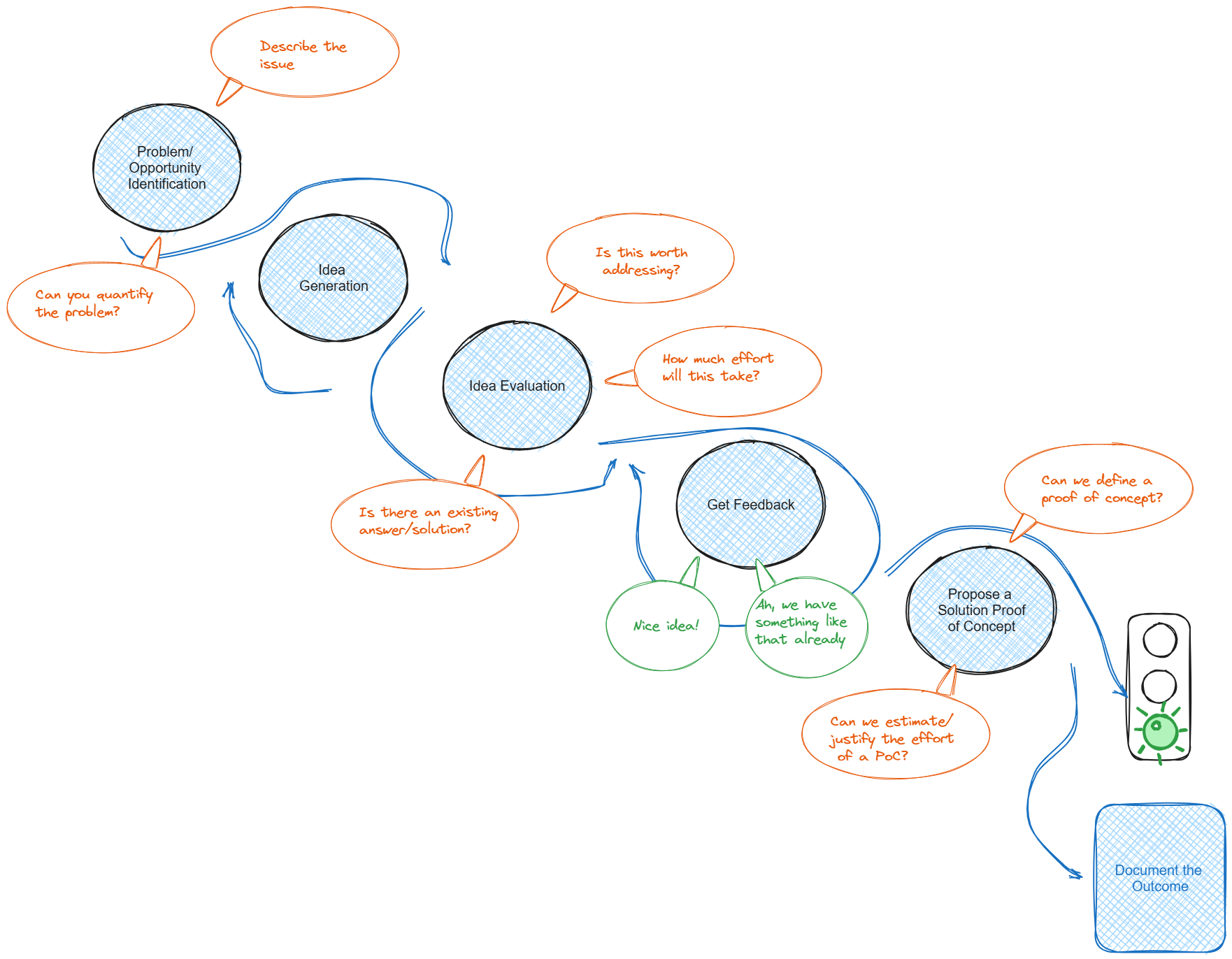
It is important to recognise each of the phases, and return to a prior phase and challenge the working assumptions before progressing to far on.
Problem/Opportunity Identification
Often, people assume these simply appear like lightbulb moments...and they do. Additionally, though, it is worth regularly pausing to assess the situation. Reflect on what is working, what is not. Consider the biggest or potentially biggest issues to address etc.
Suggested techniques for Problem & Opportunity Assessment
Formally identifying problems and opportunities around an online use case or situation related to business needs involves several structured techniques. Here are some methods you can use:
1. Use Case Analysis
- Identify Actors and Use Cases: Determine who interacts with your system (actors) and what they want to achieve (use cases). Use techniques like the User Goal Technique or CRUD (Create, Read, Update, Delete) to identify these interactions[2][4].
- Use Case Diagrams: Create diagrams to visualize actors and use cases, showing how they interact with the system. This helps in understanding the requirements and potential issues[6][8].
2. Root Cause Analysis (RCA)
- 5 Whys Method: Ask "why" multiple times to drill down to the root cause of a problem. This helps in identifying underlying issues rather than just symptoms[1][3][5].
- Fishbone Diagram: Use this visual tool to categorize potential causes of a problem, making it easier to identify root causes[3][5].
3. SWOT Analysis
- Strengths, Weaknesses, Opportunities, Threats: Assess your business situation by identifying strengths and weaknesses internally, and opportunities and threats externally. This helps in framing problems and opportunities in a broader context[3][5].
4. Gap Analysis
- Current vs. Desired Performance: Compare your current performance with desired outcomes to identify gaps. This technique highlights areas where improvements are needed[1].
5. Data Collection and Analysis
- Surveys and Feedback: Gather data through user surveys, feedback forms, or analytics tools to understand user behavior and pain points. Analyze this data to identify patterns and trends that indicate problems or opportunities[5].
Example of Identifying Problems and Opportunities
Use Case: Enhancing customer engagement on an e-commerce website.
Steps:
- Use Case Analysis: Identify actors (customers) and use cases (e.g., browsing products, making purchases). Use diagrams to visualize these interactions.
- Root Cause Analysis: Use the 5 Whys method to understand why customer engagement is low. For example, "Why are customers not returning?" might lead to discovering issues with product quality or customer service.
- SWOT Analysis: Assess internal strengths (e.g., strong product offerings) and weaknesses (e.g., poor customer service), as well as external opportunities (e.g., growing demand for sustainable products) and threats (e.g., increasing competition).
- Gap Analysis: Compare current customer retention rates with desired levels to identify areas for improvement.
- Data Collection and Analysis: Analyze customer feedback and purchase data to identify trends and patterns that suggest opportunities for enhancing engagement.
By using these techniques, you can systematically identify problems and opportunities related to your online use cases and develop targeted strategies to address them.
Citations: [1] https://www.modeliks.com/resources/business-plans/business-problem-solving-techniques [2] https://www.businessanalystlearnings.com/ba-techniques/2013/3/13/techniques-for-identifying-use-cases [3] https://www.linkedin.com/advice/1/what-problem-identification-techniques-can-you-use [4] https://www.softwareideas.net/use-case-analysis [5] https://www.6sigma.us/six-sigma-in-focus/problem-solving-techniques/ [6] https://guides.visual-paradigm.com/a-comprehensive-guide-to-use-case-modeling/ [7] https://www.forbes.com/councils/forbesfinancecouncil/2023/08/21/how-to-identify-and-solve-problems-in-your-business/ [8] https://en.wikipedia.org/wiki/Use-case_analysis
Idea Generation
Generating a large number of ideas during the ideation phase is crucial for creating innovative solutions.
Suggested techniques for Idea Generation
Here are some effective methods to achieve this:
1. Brainstorming
- Description: A collaborative technique where participants share ideas without judgment, focusing on quantity over quality.
- Implementation: Gather a diverse group, set a time limit (e.g., 20 minutes), and encourage wild ideas. Use a facilitator to ensure all voices are heard[2][4].
- Variations: Free Brainstorming, Mindful Brainstorming, and Rapid Ideation are variations that enhance creativity and focus[5].
2. Mind Mapping
- Description: A visual technique that organizes ideas around a central concept, highlighting connections between them.
- Implementation: Start with a central idea and create branches for related concepts. This helps visualize relationships and sparks new ideas[2][5].
3. SCAMPER Method
- Description: Uses a checklist to modify existing ideas by substituting, combining, adapting, modifying, putting to another use, eliminating, rearranging, or reversing elements.
- Implementation: Distribute the SCAMPER checklist, explain each point, and have participants apply these techniques to a product or process[1][5].
4. Round Robin
- Description: Participants sit in a circle and share ideas one by one, with a facilitator recording them.
- Implementation: Continue around the circle until everyone has contributed. Then, discuss and develop the ideas collectively[3].
5. Brainwalking
- Description: Combines physical movement with brainstorming. Participants write ideas on flipcharts and then walk around to add associations to others' ideas.
- Implementation: Hang multiple flipcharts with the same task. Participants write initial ideas, then walk around to add to others' ideas without discussing them[1].
6. Worst Possible Idea
- Description: Encourages participants to come up with intentionally bad ideas, which are then analyzed to find attributes that could be reversed to create viable solutions.
- Implementation: Have participants propose their worst ideas, list what makes them bad, and then brainstorm opposites to those negative attributes[4].
7. Rapid Ideation
- Description: Focuses on generating a large number of ideas quickly, often using time limits to stimulate creativity.
- Implementation: Set short intervals (e.g., five minutes) for participants to write down as many ideas as possible without worrying about feasibility[5].
These methods can be combined or adapted to suit the needs of your ideation session, ensuring a diverse and robust set of ideas.
Citations: [1] https://www.tomspike.com/en/blog/4-methods-of-idea-finding/ [2] https://www.andacademy.com/resources/blog/ui-ux-design/ideation-in-design-thinking/ [3] https://rightinformation.com/blog/ideation-workshop-top-10-practical-tools-and-techniques/ [4] https://www.indeed.com/career-advice/career-development/ideation-techniques [5] https://www.collaboard.app/en/blog/brainstorming-methods [6] https://clickup.com/blog/ideation-techniques/ [7] https://www.interaction-design.org/literature/article/introduction-to-the-essential-ideation-techniques-which-are-the-heart-of-design-thinking [8] https://www.interaction-design.org/literature/article/what-is-ideation-and-how-to-prepare-for-ideation-sessions
Idea Evaluation
Evaluating ideas for a digital website involves assessing their potential impact, feasibility, and alignment with your goals.
Suggested techniques for Idea Evaluation
Here are some effective methods to evaluate ideas for a digital website:
1. Three Lenses of Innovation
- Desirability: How wanted is this idea by users? Does it meet their needs?
- Feasibility: Can the idea be implemented with current resources and technology?
- Viability: What is the short- and long-term impact of the idea on the business?[1][5]
2. Urgency vs. Business Value Matrix
- Plot ideas based on their urgency and business value to prioritize them effectively. This helps in focusing on ideas that are both critical and valuable to the business.[1][5]
3. Idea Evaluation Matrix
- Use a structured matrix to evaluate ideas based on criteria such as scalability, strategic fit, and overall impact. This helps in objectively assessing each idea's potential.[7]
4. Cost-Benefit Analysis
- Assess the potential benefits of an idea against its costs. This includes financial costs, resource allocation, and potential risks.[7]
5. User Feedback and Testing
- Gather feedback from potential users through prototypes or mockups. Conduct usability testing to validate assumptions about user needs and preferences.
6. Website Quality Criteria
- Evaluate ideas based on website quality criteria such as usability, content quality, navigation, and accessibility. Ensure that the idea aligns with these criteria to enhance user experience.[6][8]
Example Evaluation Process
Idea: Implement a personalized product recommendation feature on an e-commerce website.
Evaluation Steps:
- Three Lenses of Innovation: Assess the desirability by gathering user feedback, feasibility by evaluating technical capabilities, and viability by analyzing potential revenue impact.
- Urgency vs. Business Value Matrix: Determine if the feature is urgent and valuable based on market trends and customer needs.
- Idea Evaluation Matrix: Use a matrix to compare this idea against others based on scalability and strategic fit.
- Cost-Benefit Analysis: Calculate the costs of development versus the potential increase in sales.
By using these methods, you can systematically evaluate ideas for your digital website and choose the most promising ones to implement.
Citations: [1] https://innovationcast.com/blog/how-to-evaluate-innovation-ideas [2] https://cdn.dal.ca/content/dam/dalhousie/pdf/library/CoreSkills/6_Criteria_for_Websites.pdf [3] https://www.rockypeaklc.com/ideaevaluation.pdf [4] http://mitiq.mit.edu/iciq/documents/iq%20conference%202004/papers/websitequalityassessmentcriteria.pdf [5] https://vizologi.com/tools-to-assess-idea-like-pro/ [6] https://iris.cnr.it/bitstream/20.500.14243/153004/1/prod_160847-doc_132035.pdf [7] https://www.qmarkets.net/resources/article/idea-evaluation-process/ [8] https://info.zimmermarketing.com/blog/how-to-evaluate-a-website-design [9] https://www.found.co.uk/blog/design-thinking-how-to-evaluate-ideas/
Get Feedback
Integrating user feedback into the ideation process is crucial for creating solutions that meet user needs and expectations.
Suggested techniques for Getting Feedback
Here’s how you can effectively incorporate user feedback into your ideation phase:
1. Gather Feedback Early and Continuously
- Use Multiple Channels: Collect feedback through various channels such as surveys, feedback widgets on your website, social media, and customer support interactions[1][3].
- Automate Feedback Collection: Implement automated email flows or in-app notifications to gather feedback at key moments in the user journey[1].
2. Analyze and Prioritize Feedback
- Centralize Feedback: Store all feedback in a single, centralized location to facilitate analysis and prioritization[1].
- Prioritization System: Establish a robust prioritization system based on factors like impact, alignment with business goals, and feasibility[1][7].
3. Incorporate Feedback into Ideation Sessions
- Feedback-Driven Brainstorming: Use gathered feedback to frame "How Might We" (HMW) questions that guide ideation sessions[7].
- Feedback-Informed Mind Maps: Create mind maps that incorporate user feedback to visualize connections between ideas and user needs.
4. Iterative Design Based on Feedback
- Prototyping and Testing: Develop prototypes based on user feedback and conduct usability testing to validate ideas[3][5].
- Continuous Improvement: Implement an iterative design process where feedback from each iteration informs the next, ensuring continuous improvement[2][6].
5. Tools and Platforms
- Feedback Platforms: Utilize platforms like Canny to collect, organize, and prioritize user feedback[4].
- Analytics Tools: Leverage analytics tools to track user behavior and gather insights that inform ideation[3].
Example of Integrating User Feedback into Ideation
Problem Statement: Enhance user engagement on a new e-commerce platform.
Feedback Collection:
- Use surveys and feedback widgets to gather insights on what features users find most engaging.
- Analyze customer support interactions for common pain points.
Prioritization:
- Prioritize feedback based on frequency and potential impact on user experience.
Ideation Session:
- Use HMW questions framed from user feedback, such as "How might we make product discovery more enjoyable?"
- Conduct brainstorming sessions focusing on ideas that address user feedback.
By integrating user feedback into your ideation process, you can create solutions that are more aligned with user needs, leading to higher user satisfaction and engagement.
Citations: [1] https://www.uxdesigninstitute.com/blog/user-feedback-in-product-design/ [2] https://www.coditude.com/insights/join-the-big-boys-leverage-user-feedback-as-a-pillar-of-design-thinking/ [3] https://moldstud.com/articles/p-incorporating-user-feedback-into-your-software-development-process [4] https://canny.io/blog/product-ideation-strategies/ [5] https://voltagecontrol.com/articles/user-testing-best-practices-enhancing-design-thinking/ [6] https://heelsandtech.com/practical-ways-to-incorporate-feedback-into-your-design-process/ [7] https://www.linkedin.com/advice/0/how-do-you-create-culture-user-feedback-your-organization [8] https://penfriend.ai/blog/integrate-user-feedback-into-product-development
Propose a Solution Proof of Concept (PoC)
By this point it should be possible to
- define the need, and justify it
- define the approach to meeting the need
- demonstrate that existing solutions are not sufficient
and hence the next step is to validate the idea with a proof of concept (PoC).
Doing a PoC itself requires some time and resources, so justifying it should be done in the same we you would approach justifying any small project.
The extent and detail of the any such propsal depends on how much time and effort is envisaged, but the following are at least the headlines that should all be considered:
Suggested project elements for a Proof of Concept proposal
Creating a proposal for a digital application proof of concept (POC) involves several key steps that help validate the feasibility and potential of your idea. Here’s a structured approach to crafting such a proposal:
1. Define the Problem and Opportunity
- Problem Statement: Clearly articulate the problem your digital application aims to solve. Identify user pain points and market gaps.
- Opportunity Description: Explain how your application addresses these issues and presents a unique opportunity for innovation or improvement.
2. Concept Definition and Goals
- Concept Overview: Provide a concise description of your digital application concept, including its core features and functionalities.
- Goals and Objectives: Outline what you aim to achieve with the POC, such as validating technical feasibility or demonstrating user value.
3. Methodology and Approach
- Technical Feasibility: Discuss how you plan to assess the technical feasibility of your application, including any new technologies or integrations.
- User Validation: Explain how you will gather user feedback and validate assumptions about user needs and preferences.
4. Success Criteria and Metrics
- Key Performance Indicators (KPIs): Define the metrics that will measure the success of your POC, such as user engagement, retention rates, or technical performance metrics.
- Acceptance Criteria: Establish clear criteria for what constitutes a successful POC outcome.
5. Timeline and Resources
- Project Timeline: Outline the timeline for completing the POC, including milestones and deadlines.
- Resource Allocation: Specify the resources (financial, human, technological) required to execute the POC.
6. Stakeholder Engagement
- Stakeholder Identification: List all stakeholders involved in the POC, including team members, users, and potential investors.
- Communication Plan: Describe how you will engage with stakeholders throughout the process.
7. Budget and Funding
- Cost Breakdown: Provide a detailed breakdown of the costs associated with conducting the POC.
- Funding Request: If applicable, specify the funding required to support the POC and how it will be utilized.
Example Proposal Structure
Title: Proof of Concept Proposal for a Digital Application Enhancing User Engagement
Section 1: Introduction
- Problem Statement: Users struggle with current engagement tools on e-commerce platforms.
- Opportunity Description: Develop an AI-driven recommendation system to enhance user experience.
Section 2: Concept and Goals
- Concept Overview: AI-powered product recommendations integrated into an e-commerce platform.
- Goals and Objectives: Validate technical feasibility and user acceptance.
Section 3: Methodology
- Technical Feasibility: Assess AI integration capabilities and data processing requirements.
- User Validation: Conduct user surveys and usability testing.
Section 4: Success Criteria and Metrics
- KPIs: User engagement metrics (e.g., time on site, click-through rates).
- Acceptance Criteria: Achieve a 20% increase in user engagement.
Section 5: Timeline and Resources
- Timeline: 6 weeks for POC completion.
- Resources: Allocate $10,000 for development and testing tools.
Section 6: Stakeholder Engagement
- Stakeholders: Development team, user group, investors.
- Communication Plan: Regular updates via email and project management tools.
Section 7: Budget and Funding
- Cost Breakdown: Development ($6,000), Testing ($2,000), Miscellaneous ($2,000).
- Funding Request: Seeking $10,000 to support POC execution.
By structuring your proposal around these elements, you can effectively communicate the value and feasibility of your digital application proof of concept to stakeholders.
Citations: [1] https://ec.europa.eu/info/funding-tenders/opportunities/docs/2021-2027/horizon/temp-form/af/af_he-erc-poc_en.pdf [2] https://www.netguru.com/blog/proof-of-concept-in-software-development [3] https://www.techtarget.com/searchcio/tip/Free-proof-of-concept-templates-for-the-CIO [4] https://flatirons.com/blog/what-is-a-proof-of-concept/ [5] https://www.smartsheet.com/content/proof-of-concept-templates [6] https://artkai.io/blog/poc-development-guide [7] https://www.linkedin.com/pulse/what-proof-concept-poc-comprehensive-writing-guide-free-nywpc [8] https://www.rst.software/blog/proof-of-concept-poc-in-software-development-and-whats-after
Creating a PoC proposal, is an exercise which should consolidate and conclude the outcomes of the prior ideation phase steps. It is a chance to recap, reflect and iterate ahead of seeking the green light to start a PoC.
Conclude Ideation - Document The Outcome
Whether the ideation phase was judged a success or failure in terms of justifying moving to a PoC, it was never time wasted ... unless you fail to capture the learnings.
It is recommended to do the following:
- Capture the artifacts from each step in the ideation phase
- Document the stakeholders involved
- Document the key findings and decisions
- Summarise the outcome
That way, the next time the idea comes up, the outcomes from this ideaation phase provide input/contact/background/guidance those considering the idea again.
Check previous outputs from Ideation for ideas, and don't immediately jump to the same concluding outcome. There may well be many reaons an idea did not take off the first time, but may well do the next time due to changing environments, scope, budgets etc.