Geography
Introduction
Geography is a fundamental consideration for any company. Here we describe how geography is defined and applied digitally
There are three points to the geography triangle
- the technology used to determine and act upon geography information
- the data categorization of geography in a standard manner
- the processes around geography in terms of content and customer
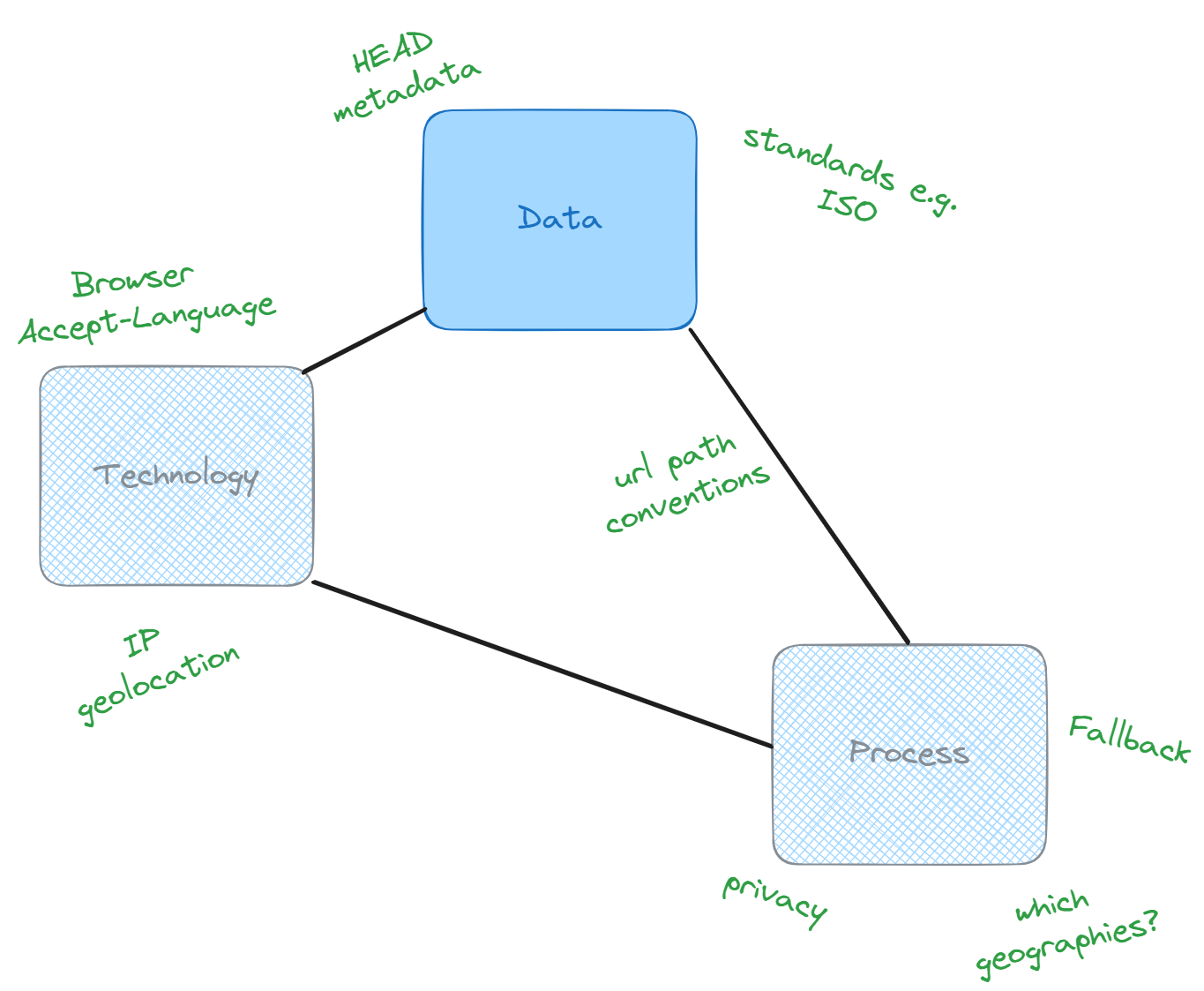
Here we focus on the data. Visit Technology and Process for the other aspects.
Considering the "data" aspects of geography, locale is the major consideration.
Introduction to Geography and Locale
When building a website with an international audience, understanding and implementing locale (country-language) considerations is crucial for creating a user-centered experience that resonates with diverse audiences. Locale refers to a set of regional preferences that shape interface, content, and terminology, making a user interface more relatable and familiar to users from different regions[6][10]. Here are the important points of locale (country and language) to consider:
Key Points of Locale in Website Development
1. Language Adaptation
- Translation and Interpretation: Ensure that content is translated accurately and culturally relevant. This includes adapting idioms, expressions, and nuances specific to each language[3][9].
- Language Support: Provide support for multiple languages to cater to diverse linguistic needs. This may involve using machine, human, or hybrid translation methods[1][8].
2. Cultural Sensitivity
- Visual Elements: Adapt images, icons, and videos to align with local cultural norms and preferences[9].
- Color Schemes: Use culturally appropriate colors that convey the intended message without offending local sensibilities[5].
3. Regional Preferences
- Date and Time Formats: Adjust date and time formats according to regional standards (e.g., MM/DD/YYYY vs. DD/MM/YYYY)[3].
- Currency and Pricing: Display prices in local currencies and consider regional pricing strategies[3][6].
- Measurement Units: Use appropriate measurement units (e.g., metric vs. imperial)[3].
4. Technical Considerations
- URL Structure: Use dedicated URLs for each language version to avoid duplicate content issues and improve SEO[2][8].
- Internationalization (i18n): Design the website with internationalization principles to facilitate easier localization and ensure compatibility across different languages and regions[4].
5. User Experience
- Layout Adjustments: Ensure that the website layout accommodates variations in text length and direction (e.g., RTL languages like Arabic)[8].
- Navigation and Accessibility: Provide a consistent user experience across all language versions, including easy navigation and accessibility features[5].
6. SEO Optimization
- hreflang Annotations: Use
hreflangannotations to help search engines direct users to the correct language version of a page[2]. - Local Search Engine Optimization: Optimize content for local search engines to improve visibility in target markets[7].
By addressing these locale considerations, businesses can create a seamless and authentic experience for their global audience, enhancing user engagement, conversion rates, and ultimately, revenue growth.
Citations: [1] https://www.weglot.com/guides/website-localization [2] https://developers.google.com/search/docs/specialty/international/managing-multi-regional-sites [3] https://toppandigital.com/translation-blog/9-key-factors-to-consider-when-localising-your-website-for-international-markets/ [4] https://poeditor.com/blog/website-localization/ [5] https://www.weglot.com/guides/multi-language-website [6] https://www.smartling.com/blog/what-is-a-locale [7] https://language.network/blog/website-localization-step-by-step [8] https://www.accelingo.com/website-translation-best-practices/ [9] https://summalinguae.com/localization/how-to-localize-your-website/ [10] https://translatepress.com/locale-vs-language/
Engagement
Reach out to the Localisation Team Lead for your brand.
Failing that, reach out to the Platform Team, who can help identity the key point of contact
Review and Approval
In a project setting, localisation activities and deliverables need to be formally scoped and approved, just like other content management considerations. Therefore consider a proposal which contains:
1. Introduction and Objectives
- Purpose: Expand the website's reach by adapting it to different cultures and languages, enhancing user experience and conversion rates.
- Goals: Increase brand visibility, tap into new markets, and boost sales by offering content in users' preferred languages.
2. Localization Strategy
- Market Research: Identify target countries and understand local preferences, cultural nuances, and market trends.
- Team Setup: Assemble a team with expertise in translation, design, and technical implementation.
- Timeline and Budget: Establish a realistic timeline and budget for the localization process.
3. Technical Implementation
- URL Structure: Choose between country code top-level domains (ccTLD), subdomains, or subdirectories based on branding and resource considerations.
- Language and Geolocation Routing: Implement a system that routes users based on both language preference and geolocation.
- Technical Adjustments: Ensure UTF-8 encoding, adapt date formats, currencies, and payment methods to local standards.
4. Content Localization
- Translation Approach: Decide on machine, human, or hybrid translation methods based on content importance and budget.
- Cultural Adaptation: Adjust images, videos, and design elements to resonate with local audiences.
- SEO Optimization: Conduct keyword research and implement hreflang tags for better search engine visibility.
5. Testing and Quality Assurance
- User Testing: Conduct usability tests with local users to ensure cultural relevance and technical functionality.
- Quality Control: Verify translations and ensure all elements are correctly localized.
6. Launch and Monitoring
- Localized Marketing Strategy: Develop marketing campaigns tailored to each region.
- Performance Metrics: Track visitor volumes, conversion rates, and SEO rankings in target markets to measure success.
7. Maintenance and Updates
- Content Management: Implement a system for easy updates and synchronization across localized versions.
- Continuous Improvement: Regularly review feedback and analytics to refine the localization strategy.
This proposal outlines a comprehensive approach to website localization, ensuring a tailored experience for users across multiple countries while maintaining brand consistency and efficiency.
The good news is that unless it is actually the launch of a new brand, these elements should be establised. Therefore the addition of a new section to an existing website, should reference the overall standards and processes and focus on
- timelines and budgets, for introducting new content and integrating it within the website, in line with the standards
- the formation of the team to execute the work (availability, training etc)
- sumamry/reference to the other aspects
It may seem excessive to cover so much for a small "translation job of a few pages". However, it is an opportunity to enquire and reflect, especially as the standard processes and tools continue to evolve. Don't assume, check and stay up to date.
Once the propsal is clearly defined and presented to stakeholders, approval should be straightforward.
Standards and Conventions
There are a diverse range of standards and conventions, many of which follow international standards such as ISO.
ISO 3166 - Name and Two Letter Country Codes
The common rules are countries are designated
- by English Name (ISO 3166 Name)
- by two-letter code (ISO 3166-1 Alpha-2)
See https://www.iso.org/iso-3166-country-codes.html (and https://www.iso.org/obp/ui/#search to view)
ISO 639 - Name and Two Letter Language Codes
The common rules are languages are designated
- by English Name (ISO 639 Name)
- by two-letter code (ISO 639-Set 1)
See https://www.iso.org/iso-639-language-code (and https://en.wikipedia.org/wiki/List_of_ISO_639_language_codes and https://www.loc.gov/standards/iso639-2/ISO-639-2_utf-8.txt to view - since the ISO official page required paid access)
Locale Designation
A locale is the combination of country plus language.
In terms of designation it is
- language-COUNTRY
- ll-CC
where the country code is expressed in Upper Case.
See list at:
Use only lower-case in urls e.g. for the UK English page, use example.com/en-gb/page.html
Where the locale value is used
There are multiple places where the locale value should be user
- the url e.g. example.com/en-gb/page.html
- the hreflang attribute in links and anchors (https://developer.mozilla.org/en-US/docs/Web/API/HTMLLinkElement/hreflang)
- the html lang value (https://www.w3.org/International/questions/qa-html-language-declarations)
Expressing Locale in the Url
There are several places to consider, and multiple potential approaches. Here we define the correct implementation for Essity
Hostname
At the DNS level, which dictates the hostname, the preferred convention is
- use a global hostname e.g. example.com
- acquire country code top level domain (ccTLD) variations e.g. example.co.uk and redirect traffic to the single global domain using 308 (301) permanent redirects
It is a historic but still widely held belief that a ccTLD is noticably better for SEO. In reality, it is still a "strong indicator" but there are alternatives to be considered (See https://developers.google.com/search/docs/specialty/international/managing-multi-regional-sites?hl=en).
From these, the use of
- .com
- redirection of ccTLDs
- other locale indicators (url root path, page META)
is preferrable, unless the brand is present in only a single country.
The advantages are
- greater presence of the single site (one site with 100 pages, rather than 100 sites with one page).
- much lower maintenance of the overall hosting environment (one site, one domain, one hosting configuration, one server certificate compared to duplicating for each ccTLD)
- the advantage may be debatable with a single brand site, but as the complexity increases with the modern Web (ecommerce, APIs etc) the cost/effort argument to keep it simple/singular is clear
Url Path
-
Locale Root
- The url path should begin with locale expressed as /ll-cc/ i.e. language-country (in lower case). This is a well recognised convention.
- Use of language or country alone does not indicate which it is, unless in conjunction with a ccTLD.
- For a .com, it is needed to clearly separate locales e.g. consider DACH, with /de-at/, /de-ch/ and /de-de/ representing Austria, Switzerland and Germany, or Canada with /en-ca/ and /fr-ca/ for the English and French variations.
-
English vs local language path
- there are pros/cons for each
Local Language
| Pros | Cons |
|---|---|
| Keyword Inclusion: Including keywords in the local language in URLs may improve search visibility | |
| because users are more likely to search using their native language. This can enhance click-through rates (CTR) as users are more inclined to click on URLs that match their search term | Complexity: Translating URLs can add complexity and maintenance overhead, especially if the site structure changes frequently |
| User Experience: Local language URLs can make shared links more understandable and appealing to users, potentially increasing engagement and trust in the site | --- |
| URL Readability: Using readable words in URLs is recommended for better user experience and search engine crawling | --- |
| Crawling and Indexing: Google can effectively crawl and index pages with language-specific URLs, which helps in ranking them appropriately for different languages | --- |
| Non-Latin Characters: Google can crawl and index URLs with non-Latin characters, making it feasible to use local languages in URLs | --- |
English
| Pros | Cons |
|---|---|
| Consistency: For administrative or technical parts of the site (e.g., login, checkout), using English can maintain consistency across languages | SEO Ranking: Using English words in the url, without further local language e.g. in HEAD meta and BODY content will perform less well in SEO |
| URL Structure: A common approach is to use a locale code in the URL path (e.g., /en-gb/, /es-mx/) rather than translating the entire path | --- |
| Goe-Redirection: If only the locale changes, rules based geolocation of users the correct content is easily maintanced e.g. on-pack QR code redirectio | --- |
Ultimately, the choice depends on the target audience, the type of content, and the balance between SEO benefits and technical complexity. For most cases, using a locale code in the URL path (e.g., /en-gb/, /es-mx/) is a practical approach, while including local language keywords in the URL path can enhance SEO and user experience.
This can be achieved either
- manually curate the content (and accept challenge in maintaining rules based redirection)
- automatically using a rule based convention for the initial part of the path, followed by an seo-friendly latter part (which is respected by SEO but ignored by the hosting)
Real-world examples
There are plenty examples from 3rd parties to consider e.g.
- the big tech companies like Microsoft and Facebook favour .com, and redirect ccTLD traffic, yet choose differing locale approachs e.g. in Germany microsoft.com/de-de/ and de-de.facebook.com
- brand/consumer driven companies show inconsistences in approach e.g. look at https://www.unilever.co.uk/brands/ or https://www.kimberly-clark.com/de-de/ and you will see a mix of .com and ccTLDs/ll-cc/ based localisation.
Best Practice
So there is no one best answer. For Essity, it is recommended to
- use .com
- start the path with the locale /ll-cc/
- preferably provide the initial (content) portion of the url in English
- optionally support SEO by providing a subsequent (seo) portion of the url in local language
For example,
- the Swedish Tork soap dispenser at https://www.torkglobal.com/se-sv/products/565200/dispenser/toalett-tillbehor
- the German Tork soap dispenser at https://www.torkglobal.com/de-de/products/565200/spender/waschraum-zubehoer
- the British Tork soap dispenser at https://www.torkglobal.com/en-gb/products/565200/dispenser/washroom-accessories
then if you need to infer/redirect from one locale to the other you simply
- remove the subsequent portion of the url (after /565200)
- change the locale from one to another
- redirect to the new page e.g. https://www.torkglobal.com/fr-fr/products/565200 (without the SEO portion)
- handle https://www.torkglobal.com/fr-fr/products/565200 with e.g.
- add the correct canonical link (https://www.torkglobal.com/fr-fr/products/565200/distributeur/accessoires-sanitaires) in the page META of https://www.torkglobal.com/fr-fr/products/565200
- alternatively redirect to https://www.torkglobal.com/fr-fr/products/565200/distributeur/accessoires-sanitaires
- if a 404 condition, calculate the next best response e.g. https://www.torkglobal.com/fr-fr/products/distributeur/accessoires-sanitaires
Further Reading
- Internet RFC 5646 - Tags for Identifying Languages https://datatracker.ietf.org/doc/html/rfc5646
- Declaring language in HTML - https://www.w3.org/International/questions/qa-html-language-declarations